
How to Play Color Cards
Color Cards is a colour-matching shedding game played with our own 108-card deck. If you have played similar games with friends, you will feel at home within a minute; a few rules are worth checking, though, because house rules for this type of game vary a lot. This guide explains how to play Color Cards exactly as it works in our free Color Cards game.
Play nowGoal
Empty your hand before everyone else. The winner of each deal scores points for the cards left in the other players' hands, and the first player to reach the match target wins: 300 points with four players, 150 with two.
The deck
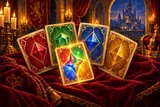
- Four colours, named after jewels: Ruby, Emerald, Sapphire and Topaz. Each colour also has its own shape printed on the card.
- In each colour: one 0, two each of the numbers 1 to 9, two Skip, two Reverse and two +2 cards. That makes 25 cards per colour.
- Four Wild cards and four Wild +4 cards, which have no colour of their own.
- 108 cards in total.
Starting a deal
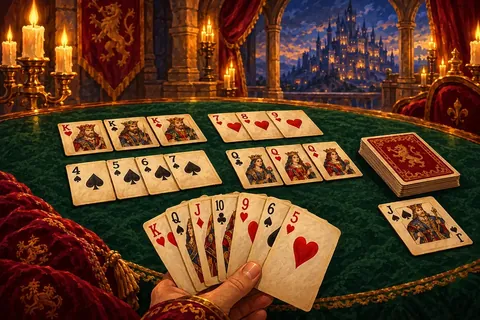
Each player receives seven cards. Against the computer there are four players: you, West, North and East. In two-player mode there are two. The next card is turned face up to start the discard pile; it is always a number card, never an action or a wild. The rest of the cards form the deck.
Taking a turn
- Play one card that matches the top card of the pile by colour, or by symbol (the same number, or the same action such as Skip on Skip).
- Or play a Wild card on anything and choose the next colour.
- Or play a Wild +4 and choose the next colour, but only if your hand holds no card of the current colour.
- If you do not play, tap the deck to draw one card.
- If the drawn card fits, you may play it, or pass. You may play only that drawn card, not another card from your hand.
- If the drawn card does not fit, your turn ends automatically.
Action cards
A player who has to draw cannot avoid it by playing another +2 or +4. Penalties are never stacked in our game, and a Wild +4 cannot be challenged.
- Skip: the next player misses their turn.
- Reverse: play changes direction. With two players it acts like a Skip.
- +2: the next player draws two cards and misses their turn.
- Wild: choose any colour to continue.
- Wild +4: choose a colour; the next player draws four cards and misses their turn.
Last card and scoring
When a player is down to one card, a "Last card!" message appears for everyone. There is nothing to call and no penalty. When a player plays their final card, the deal ends and they score:
- Number cards: their face value.
- Skip, Reverse and +2: 20 points each.
- Wild and Wild +4: 50 points each.
Strategy
- Hold a Wild for when no other card fits, but play it before it costs you 50 points.
- Keep a +2 or Skip for the player who is about to go out.
- Change colour by matching symbols to leave opponents stranded.
- Pick the colour you hold most of after a Wild.
- Try these ideas in Color Cards vs computer or in 2 player Color Cards.
Common mistakes
- Trying to play a Wild +4 while holding a card of the current colour.
- Expecting to answer a +2 with your own +2.
- Drawing a card and then trying to play a different card from your hand.
Glossary
- Discard pile: the face-up pile you match.
- Symbol: the number or action shown on a card.
- Action card: Skip, Reverse or +2.
- Wild: a card without colour that sets the next colour.
FAQ
- How many cards does each player get?
- Seven, whether you play against the computer or with two people.
- Can I play a Wild +4 at any time?
- No. Only when you have no card of the current colour. A normal Wild can be played at any time.
- After drawing, can I play any card?
- No. You may play only the card you just drew, and only if it fits.
- Why are the colours named after jewels?
- It is our own deck design. Each colour also has a shape, so colour-blind players can tell the cards apart.