
How to Play FreeCell
Here is how to play FreeCell, explained the way our game actually works. If you know Klondike, you already know half of it: columns are built down in alternating colours and foundations up by suit. What makes FreeCell different is that every card is visible from the start and four free cells give you temporary storage.
Play nowThe goal
Move all 52 cards onto the four foundations, one per suit, from Ace up to King. When the last King lands, you have won, and the win screen shows your time and number of moves.
The layout
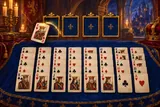
- Eight columns holding the whole deck face up: four columns of seven cards and four of six.
- Four free cells, empty at the start. Each can hold any single card.
- Four foundations, empty at the start, one for each suit.
- There is no stock and no waste: every card is already on the table.
How to play, step by step
- Scan the deal. Find the Aces and note what is covering them.
- Move the last card of any column onto a card one rank higher and of the opposite colour, for example a black 4 onto a red 5.
- Park a card in a free cell when it is in the way. Any card can go there, but each cell holds just one.
- Bring cards back from the free cells as soon as they fit on a column or a foundation.
- Fill an empty column with any card or ordered run. Unlike Klondike, it does not have to be a King.
- Build each foundation by suit: Ace, then 2, then 3, up to King. Cards that are clearly safe are moved there automatically.
- Move runs. A run in descending order and alternating colours can be moved in one go if there is enough free space to do it one card at a time.
Supermoves: how many cards can you move?
Officially you move one card at a time, but the game does the shuffling for you through free cells and empty columns. The longest run you can move equals the number of empty free cells plus one, doubled for each empty column. With 3 empty cells and no empty column you can move 4 cards; with 1 empty cell and 2 empty columns, 8 cards.
If you are moving the run into an empty column, that column does not count in the calculation, so the limit is lower.
Winning and getting stuck
There are no points in FreeCell: what counts is winning, ideally in fewer moves and less time. You are stuck only when every free cell is full, no column is empty and no legal move remains. The game then offers to undo, restart the deal or start a new one.
Almost every deal can be won. One well-known impossible deal is excluded, and only a tiny number of other unsolvable ones exist.
Strategy
- Empty a column early. It is the most powerful resource in the game.
- Keep at least one free cell open whenever you can. A full set of cells leaves you no room to manoeuvre.
- Dig out Aces and 2s first; auto-play then clears the low cards and opens space.
- Plan several moves ahead. Since nothing is hidden, you can often see the whole route to freeing a card.
- Prefer long ordered runs in the columns; they move as one with enough space.
Common mistakes
- Filling all four free cells early in the game.
- Putting a single card into an empty column when a whole run could have gone there.
- Moving cards without a goal. Every move should free something specific.
- Forgetting that Restart this deal lets you try the same cards with a better plan.
Glossary
- Free cell: one of four spaces that each hold a single card temporarily.
- Foundation: a pile built by suit from Ace to King.
- Column or cascade: one of the eight piles of face-up cards.
- Run: cards in descending order with alternating colours.
- Supermove: moving a whole run at once using empty cells and columns.
- Auto-play: the game sending safe cards to the foundations by itself.
FAQ
- What does safe auto-play mean?
- Aces and 2s always go up automatically. Other cards go up once no card of the opposite colour could still need them as a place to build on.
- Is FreeCell harder than Klondike?
- It needs more planning, but because all cards are visible, nearly every game can be won. In Solitaire luck plays a much bigger part.
- How does the hint work?
- After a short video, the game asks a solver for a good next move and highlights it.
- Where can I play?
- Open FreeCell and try a deal. You can also compare it with Spider Solitaire, another solitaire built on planning.