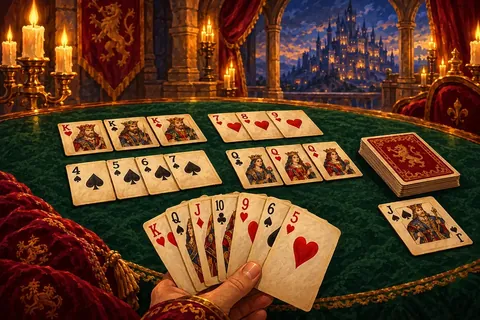


How to Play French Tarot
This guide explains how to play French Tarot, the trick-taking game that fills French cafés and club rooms. It uses a special deck with 21 trumps and an Excuse, and each deal pits one player, the taker, against the other three. The rules here are those of the four-player game used in our free French Tarot game.
Play nowGoal
In each deal, the taker tries to win enough card points in tricks to make their contract, while the three defenders try to stop them. Scores move between the taker and the defenders after every deal. A match lasts four deals, and the player with the highest total wins.
The deck
- Four suits of 14 cards: 1 to 10, jack, cavalier (knight), queen and king.
- 21 trumps, numbered 1 to 21. Every trump beats every suit card.
- The Excuse, a special card that is neither a suit nor a trump. In our game it is drawn as a jester's hat.
- The oudlers are the 1 of trumps, the 21 of trumps and the Excuse.
Card points
- Each oudler: 4.5 points.
- King: 4.5. Queen: 3.5. Cavalier: 2.5. Jack: 1.5.
- Every other card: 0.5.
- The whole deck adds up to 91 points.
The deal and the bidding
- Each of the four players receives 18 cards. Six cards are placed face down as the dog.
- Each player bids once, and only higher bids are allowed: Small (×1), Guard (×2), Guard without (×4) or Guard against (×6). A player may also pass.
- The highest bidder becomes the taker. If all four pass, the cards are dealt again.
The dog
- Small and Guard: the taker turns the dog face up, adds the six cards to their hand and then puts six cards aside. These count for the taker at the end. Kings and oudlers may not be put aside; trumps only if there is no other choice.
- Guard without: the dog stays face down but counts for the taker.
- Guard against: the dog stays face down and counts for the defenders.
Playing the tricks
- Play goes clockwise; the winner of each trick leads the next.
- You must follow the suit led if you can.
- When trumps are led, you must play a trump higher than those already played, if you can.
- If you cannot follow suit, you must play a trump, and beat the highest trump in the trick if possible.
- The Excuse may be played at any time instead. It never wins the trick, but it normally returns to its owner's pile, who gives a low card in exchange. Played in the last trick, it does not come back.
- The highest trump wins the trick; otherwise the highest card of the suit led wins.
Scoring a deal
The taker counts the card points in their tricks and the cards put aside. The target depends on the oudlers they hold at the end: 56 points with none, 51 with one, 41 with two and 36 with all three.
The deal is worth 25 points plus the difference between the taker's points and the target. If the 1 of trumps wins the very last trick, 10 is added for the side that won it (or subtracted when the defenders did). The total is multiplied by the contract: 1, 2, 4 or 6. The taker wins or loses this amount from each defender, so the taker's score changes three times as much and the scores always add up to zero.
Strategy
- Bid on long trumps and oudlers, not on many small suit cards.
- As taker, put aside cards that create a void, so you can trump that suit.
- As defender, give your points (kings, queens) to a fellow defender who is winning the trick.
- Keep the 1 of trumps safe; play it when a higher trump cannot capture it.
- Try these ideas against three levels in French Tarot vs computer.
Common mistakes
- Bidding Guard on a hand with few trumps and no oudlers.
- Forgetting that when trumps are led you must go higher if you can.
- Keeping the Excuse until the last trick, where it is lost.
Glossary
- Taker: the player who won the bidding and plays alone.
- Dog: the six cards set apart at the deal.
- Oudler: the 1 and 21 of trumps and the Excuse.
- Petit au bout: winning the last trick with the 1 of trumps.
FAQ
- How many cards are in a French Tarot deck?
- 78: four suits of 14 cards, 21 trumps and the Excuse.
- Can the Excuse win a trick?
- No. It excuses you from following suit or trumping, but it never wins the trick.
- Are handfuls and slams counted?
- Not in our game. Scoring uses the contract, the difference and the 1 of trumps in the last trick.
- How many deals are in a match?
- Four in our game. The highest total wins, and a tie for first counts as your win.