

How to Play Gin Rummy
This guide explains how to play rummy in its most popular two-player form, Gin Rummy. Every rummy game shares the same idea: draw and discard until your cards form sets and runs. Gin adds the knock, a way to end the hand early when your leftover cards are low. These rules match our free Gin Rummy game.
Play nowGoal
Arrange your hand into melds while keeping your unmatched cards, the deadwood, as low as possible, then end the hand before your opponent does. Points are scored hand by hand, and the first player to reach 100 wins the match.
Cards and values
- One standard 52-card deck, two players.
- Aces count 1, number cards their face value, and jacks, queens and kings 10 each.
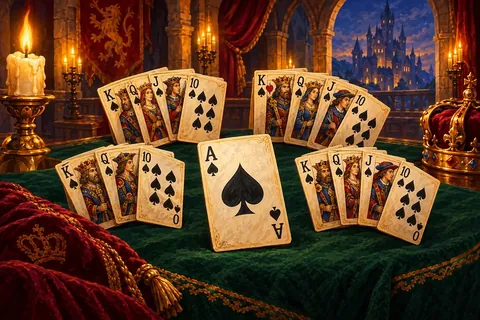
- Aces are low only: A-2-3 is a run, Q-K-A is not.
Melds
- Set: three or four cards of the same rank, such as three 9s.
- Run: three or more cards of the same suit in sequence, such as 4-5-6 of diamonds.
- A card can belong to only one meld at a time. Our game finds the best arrangement for you automatically and shows your deadwood total.
The deal
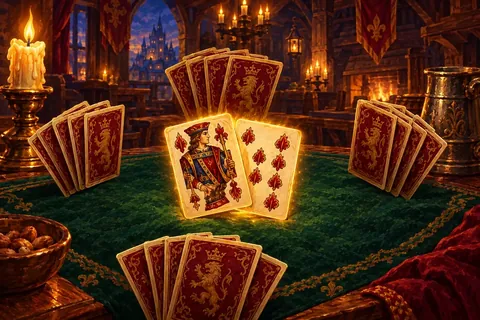
Each player receives ten cards. The next card is turned face up to start the discard pile, and the rest form the deck. In our game you play the first hand; afterwards the winner of each hand deals the next.
A turn, step by step
- Draw one card: either the top card of the deck or the face-up top card of the discard pile (the button shows Take and the card).
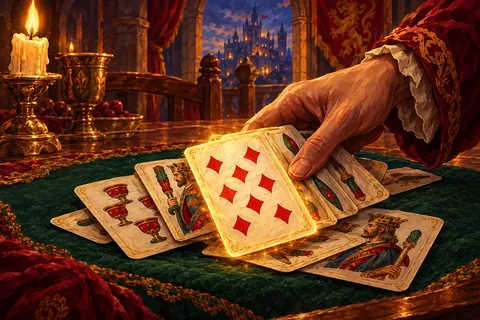
- Rearranging is done for you: cards that form melds glow and move to the front of your hand.
- Discard one card face up by tapping it twice. You may not discard the same card you just took from the discard pile.
- If your deadwood is now 10 or less, you may knock instead of an ordinary discard (see below).
Knocking and gin
When your deadwood is 10 or less, the Knock button appears. Tap it, then choose the card to discard face down. If all ten remaining cards form melds, the button reads Gin! and you score a bonus.
After a knock, the defender lays off any loose cards that extend the knocker's melds; our game does this automatically. Lay-offs are not allowed against gin.
Scoring
Some home rules add bonuses for big gin or for each hand won. Our game keeps to the core scoring above.
- Knock: the knocker scores the difference between the two deadwood totals.
- Undercut: if the defender's deadwood is equal to or lower than the knocker's, the defender scores the difference plus 25.
- Gin: the player who went gin scores the opponent's deadwood plus 25.
- Dead hand: if the deck is down to two cards and nobody has knocked, the hand is cancelled and nobody scores.
- Match: first to 100 points.
Strategy in brief
Discard high cards that do not fit early, keep flexible cards that could join a set or a run, and watch what your opponent takes from the discard pile. Knock early when you can; late knocks invite undercuts. More in our Gin Rummy tips and tricks.
Common mistakes
- Counting Q-K-A as a run.
- Hoping for gin too long and getting knocked on with a hand full of picture cards.
- Forgetting that the defender's lay-offs can turn your knock into an undercut.
Glossary
- Deadwood: cards not in any meld, counted in points.
- Knock: ending the hand with 10 or less deadwood.
- Gin: ending the hand with no deadwood at all.
- Lay off: adding a loose card to the knocker's meld.
- Undercut: when the defender's deadwood is not higher than the knocker's.
FAQ
- How many cards do you get in Gin Rummy?
- Ten each, with one more card turned face up to start the discard pile.
- How do you play rummy with 2 players?
- Gin Rummy is designed for two. Draw, discard, build sets and runs, and knock when your deadwood is 10 or less. You can try it with a friend on one device in 2 player Gin Rummy.
- Can an ace be high in a run?
- Not in Gin Rummy. Aces are always low, so only A-2-3 runs are possible with an ace.
- What happens if the deck runs out?
- When two cards are left in the deck without a knock, the hand is dead and nobody scores.