
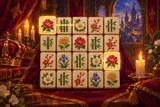
How to Play Mahjong Connect
This page explains how to play Mahjong Connect step by step, exactly as the game works here. The whole game rests on one rule, the connecting path, and once you can see paths at a glance, the board starts to open up quickly.
Play nowGoal
Remove every tile from the board by matching identical tiles in pairs. A pair can only be removed when the two tiles can be connected by a valid path.
The board
- One flat rectangle of tiles: no layers, no stacks.
- Easy: 8 columns by 5 rows. Medium: 12 by 7, the default. Hard: 14 by 8.
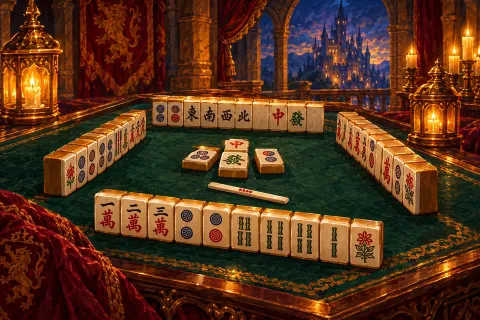
- Tiles use the classic mahjong designs: bamboo, characters and circles, winds, dragons, flowers and seasons.
- An empty border runs around the board. Paths may use it.
Making a match
- Find two tiles with the same picture. Any flower pairs with any flower, and any season with any season.
- Imagine a line from one tile to the other that passes only through empty cells or the border.
- The line may be straight, turn once, or turn twice. Three straight segments is the maximum.
- If such a line exists, tap the first tile and then the second. The path flashes and both tiles are removed.
- If not, the second tile you tapped becomes the selected one, so you can try again from there.
- Repeat until the board is empty.
Examples of the path rule
- Two matching tiles side by side always connect: the path has no turns at all.
- Two tiles in the same row with only empty cells between them connect with one straight line.
- Two tiles at the top edge connect through the border, even with a full row between them.
- An L-shaped path has one turn; a U- or Z-shaped path has two. A path needing three turns is not allowed.
When you get stuck
Every deal is built backwards from an empty board, so a solution always exists at the start. Still, an unlucky order of matches can leave no connectable pair. Then the game shows No more pairs available. You can shuffle the remaining tiles after a short video, and the new arrangement is again solvable. You can also undo for free, try the same board again or start a new game. There is no shuffle button outside this screen.
Scoring
- 10 points for each pair removed.
- A time bonus when you clear the board: about 7 seconds are allowed for each pair, and every second you finish under that total earns 2 points.
- Time, tiles left and score are shown in the bar.
Strategy
Work from the outside in. Tiles on the edge can always use the border, so they are the cheapest pairs, and clearing them gives the inner tiles room to connect.
Think in fours. Each normal picture appears four times. If you remove the two easy ones first, the remaining two may be trapped deep inside. When you have a choice, remove the pair whose partners will be hardest to reach later.
Make corridors. An empty row or column is a highway for paths, and many pairs suddenly become legal once one is clear.
Flowers and seasons are flexible because any two of a kind match. Save them as a reserve for awkward positions.
Reading the board quickly
Experienced players scan in a fixed order. First, look for identical tiles that touch; they always connect. Next, check each edge row and column, because border paths are the easiest to see. Then look along any fully empty row or column for tiles at both ends of it. Only after that, trace the more complex L-, U- and Z-shaped paths through the middle. If two matching tiles almost connect but one tile blocks the path, remember that tile: clearing it first may open several pairs at once.
On the Hard board with 112 tiles, this routine saves a lot of time, and it makes a hint rarely necessary.
Common mistakes
- Counting turns wrong: three turns are never allowed.
- Forgetting the outer border as a route.
- Taking the easiest pair of four without thinking about the other two.
- Expecting tiles to slide after a match; on this board they stay in place.
Glossary
- Path: the line connecting two tiles, at most three straight segments.
- Turn: a change of direction in the path; two at most.
- Border: the empty frame around the board that paths may use.
- Pair: two matching tiles removed together.
- Shuffle: rearranging the remaining tiles, offered only when stuck.
FAQ
- Do tiles have to be next to each other?
- No. They only need a clear path with at most two turns.
- Do flowers have to be the exact same flower?
- No. Any flower matches any flower, and any season matches any season.
- Is every board solvable?
- Yes, every starting board can be cleared, and a shuffle when stuck keeps it solvable.
- Where can I play the stacked version?
- Try Mahjong, the classic layered Mahjong Solitaire.