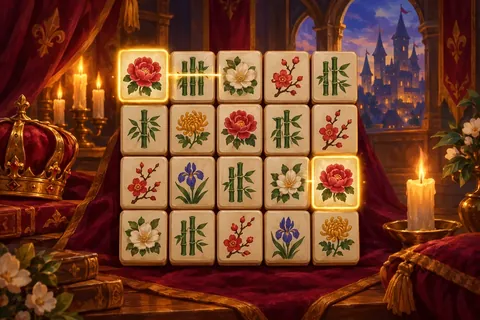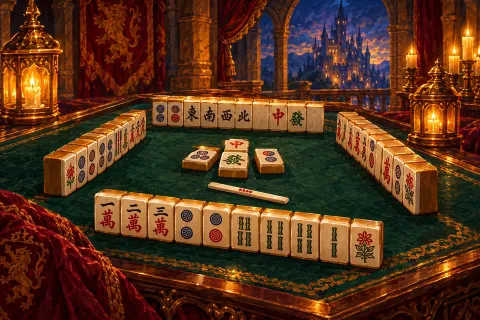


Mahjong Tips and Strategy
Good mahjong strategy in the solitaire game comes down to one question, asked before every pair: which tiles will this free? Clearing the board is not about speed of spotting, it is about the order in which you take the pairs. These tips apply to all ten layouts of our Mahjong game.
Play nowBeginner tips
- Look at the whole board before your first pair. Note where tall stacks and long rows are.
- Prefer pairs that free something. A pair at the end of a row that opens the next tile beats a pair sitting alone that opens nothing.
- Work from the top down. Tiles on high layers cover several tiles below them, so removing them early opens the most.
- Watch the Pairs counter in the bar. It shows how many matches are available right now; when it falls to one or two, slow down.
Three or four of a kind
Each ordinary tile design appears four times. When you can see two free copies, the choice is simple. With three free copies, it is the most important decision on the board: take the two whose removal opens the most new tiles, and leave the third where it blocks the least. With all four free, take them as two pairs at once; there is no reason to wait.
The real danger is the case where three copies are free and the fourth is buried under one of them. If you take the wrong pair, the remaining copy can never meet its partner. Before matching, check where the fourth copy lies.
Intermediate strategy
- Open long rows from both ends. A row freed only from the left must be cleared tile by tile in one direction.
- Release tiles that block two others first. A tile sitting between two columns of a stack often holds both back.
- Keep flowers and seasons in reserve. Because any flower matches any other flower and the same holds for seasons, they are easy pairs to keep for a moment when you need a free move.
- Do not clear one area completely while another stays untouched. A balanced board offers more choices later.
Advanced: reading the layout
Different layouts call for different plans. On the Turtle, the high stack in the centre hides many tiles, so start freeing it early. On flatter layouts, more tiles are free from the start, and the danger lies in using up matches carelessly.
As the board thins out, count. If you can account for where every remaining copy of a design is, you can often see the whole route to the finish, and avoid the last-minute dead end.
Undo, hint and shuffle, used wisely
Undo is free, so use it to explore. If a pair turns out to free nothing, take it back and try another. The hint, unlocked with a short video, highlights the pair that frees the most tiles, which is also a good way to learn what a strong move looks like.
If no pairs remain, the No more pairs available dialog appears. Before choosing Shuffle, which needs a short video, try a few undos: going back three or four pairs and choosing differently often solves the problem and teaches you something.
Mistakes to avoid
- Taking the first visible pair without asking what it frees.
- Using up flowers and seasons at the start, then lacking an easy match later.
- Leaving a tall stack until the end, when its hidden tiles are the ones you need.
- Assuming a reshuffle is always available. It only appears when you are stuck, and only through a video.
FAQ
- Is there really a strategy to mahjong solitaire?
- Yes. Spotting pairs is the easy part; choosing the order in which to take them decides whether you clear the board.
- Which layout is best for practising?
- Start on the Turtle, the classic layout, then try others such as Butterfly or Fortress from the New game dialog.
- Does using the hint lower the score?
- No. The score depends only on how long you take to clear the board.
- Where are the basic rules?
- In how to play Mahjong.