
How to Play Okey (Tile Rummy)
This guide shows how to play Okey, the tile rummy that is a favourite pastime in Turkey. Four players each work on a rack of tiles, swapping one tile per turn, until somebody turns the whole rack into sets and runs or seven pairs. A wild tile called the okey changes every hand and makes each deal feel different.
Play nowGoal
Be the first to complete a winning hand, and over the whole game keep as many of your starting points as you can. Everyone begins with 20 points, and the game ends when one player's total reaches zero.
The tiles
- Numbers 1 to 13 in four colours: yellow, blue, black and red.
- Each tile exists twice, which makes 104 numbered tiles.
- Two false okeys, drawn in our game with a burgundy crown, bring the total to 106.
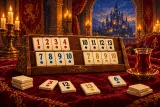
- Our tiles also show a small shape for each colour, which helps players who find some colours hard to tell apart.
Setup
- The tiles are shuffled face down and one tile is turned up: the indicator.
- The okey for this hand is the tile with the same colour and the next number. If the indicator is a red 7, the red 8s are okeys; after 13 comes 1.
- The two okey tiles are wild and can stand for any tile. The false okeys are not wild: they simply play the part of the okey tile, the red 8 in this example.
- Each player receives 14 tiles. The player to the dealer's right receives a fifteenth tile and starts the hand by discarding.
- The remaining tiles form the draw pile in the middle.
Playing a turn
- Take one tile: the top tile of the draw pile, or the tile the player on your left has just discarded.
- Now you hold 15 tiles. Rearrange them on your rack to see your groups.
- Discard one tile to your right, where the next player may take it.
- Play continues to the right, which is anticlockwise around the table.
Valid groups
- Set: three or four tiles with the same number, each in a different colour. Two tiles of the same colour cannot be in one set.
- Run: three or more consecutive numbers in one colour, such as blue 4-5-6-7.
- The 1 may follow the 13 at the top of a run (12-13-1), but a run cannot carry on past it (13-1-2 is not allowed).
- Pairs: a hand of seven pairs of identical tiles also wins. A wild okey can pair with any tile.
Finishing a hand
When your 15th tile is in hand and the other 14 are all in sets and runs, or form seven pairs, you finish by laying that last tile in the centre instead of discarding it. In our game you drag it to the centre or tap it and press Finish; if the hand is not complete yet, the game tells you so.
If the draw pile runs out before anyone finishes, the hand does not count and the same dealer deals again.
Scoring
- A normal finish: each other player loses 2 points.
- Finishing by throwing an okey as the last tile, or with seven pairs: each other player loses 4.
- Seven pairs and an okey finish together: each other player loses 8.
- Showing the indicator: before your first move of a hand, a player who holds the tile matching the indicator may show it, and every other player loses 1 point. Only the first player to show it counts.
- When a player reaches zero or less, the game is over and the highest total wins.
Strategy
Arrange your rack often. Seeing your runs and sets clearly makes it much easier to decide which tile is truly spare. Keep okeys for the end if you can: they fill any gap, and finishing with one doubles the cost for the others.
Pay attention to your neighbours. The player on your right takes your discards, so avoid throwing tiles that obviously fit what they picked up earlier. The player on your left feeds you, and their throws show what they do not need.
Common mistakes
- Treating the false okey as wild. It is only a stand-in for the okey tile.
- Building a set with two tiles of the same colour.
- Planning a run that wraps from 13 to 1 and on to 2.
- Forgetting to show the indicator before your first move.
Glossary
- Gösterge: the indicator tile turned up at the start.
- Okey: the wild tile, one number above the indicator in its colour.
- Sahte okey: a false okey tile.
- Istaka: the rack that holds your tiles.
- Per: a set or run.
FAQ
- How many players does Okey need?
- Four, each playing alone. In our game you play against three computer opponents.
- Can a run go from 13 to 1?
- Yes, 12-13-1 is a valid run. It cannot continue past the 1 to make 13-1-2.
- Is a false okey wild?
- No. It counts as the specific tile that is the okey in this hand.
- How is Okey different from mahjong?
- Both use tiles, but Okey has rummy rules: sets, runs and a single discard each turn. You can try Mahjong solitaire on our site too.