
How to Play Pattern Logic
Pattern Logic is about one skill: seeing the rule behind a set of figures or numbers. Sometimes a shape turns, sometimes numbers double, sometimes one figure in five quietly breaks the pattern. This guide explains the four puzzle types, the rules you will meet in each, how a run is scored, and a step-by-step way to crack puzzles you are stuck on.
Play nowHow a run works
- Choose a level with New game: Easy, Medium or Hard.
- Pick a puzzle type on the tabs: Next in line, Numbers, Grid or Odd one out. Switching type mid-run asks "Switch puzzle type?" and starts a new run.
- Press Start. A run is 15 puzzles. After puzzles 5 and 10 the game warns "Harder puzzles ahead".
- Tap your answer, or press 1 to 6 on the keyboard.
- Read the feedback: Correct!, Not quite or Correct, with a hint. The right piece drops into the "?" slot and The rule explains the logic.
- Press Next puzzle, and after the fifteenth See result.
Next in line
You see four figures in a row (five on harder steps) and an empty card. Pick the one that comes next. The rules include: turning by 90° each step (later 45° or 135°), one figure more or fewer each step, a small gold gem moving around the card, two or three colours, shapes or fills (solid, outline, half) repeating in order, and two sizes taking turns. The easiest puzzles change one feature; the hardest change up to three at once.
Numbers
Five numbers are shown (six or seven later). Find the rule and pick the next one. Rules range from simple steps (add, subtract, multiply, divide) to two alternating steps, a step that grows, square numbers, cube numbers, primes, each number being the sum of the two before, two sequences woven together, and "multiply, then add or subtract". All numbers are whole, positive and at most 9,999. After you answer, the steps between the numbers are written in, and woven sequences are coloured blue and red.
Grid
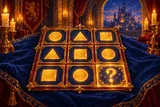
A 3×3 grid is missing its bottom-right cell. Rules work along the rows or columns: each row keeps one shape, colour or fill; each row holds the same three shapes, colours, counts or fills in a different order; the count grows or falls along the row; or the figure turns along the row. On the hardest steps, line frames combine: the third frame shows all lines of the first two, only the lines in exactly one of them, the first minus the second, or only the shared lines.
Odd one out
Five figures, one misfit. Four share a rule and you tap the one that breaks it. Look for colour, shape, an even or odd number of figures, a number of dots equal to the number of sides, or a mirror image hiding among turned copies of the same pennant.
Scoring and stars
- Each right answer is worth 100 points plus a speed bonus of up to 50, full for an instant answer and gone after 20 seconds.
- Right answers in a row build a combo: ×1.25 after 3, ×1.5 after 6, ×1.75 after 9 and ×2 after 12.
- A wrong answer scores nothing and resets the combo. A hinted answer scores half.
- 8, 11 or 14 right out of 15 earn one, two or three stars: Good thinking, Sharp mind or Brilliant!. Fewer than 8 shows Keep practising.
A method for hard puzzles
- One feature at a time: list what can change (angle, count, colour, shape, fill, size, gem position) and check each.
- Differences first: in Numbers, write the gaps between neighbours. Equal gaps mean adding; growing gaps mean a growing step; gaps that look like the numbers themselves suggest the sum of the two before.
- Every other one: if nothing fits, look at positions 1, 3, 5 and 2, 4 separately.
- Eliminate: if an option breaks even one observed rule, cross it out mentally.
- Use the hints wisely: the first press removes two wrong options, the second states the rule in words.
Glossary
- Run: a set of 15 puzzles.
- Fill: how a shape is drawn: solid, outline or half.
- Woven sequence: two sequences alternating in one row.
- Combo: the multiplier for consecutive right answers.
FAQ
- Is there ever more than one right answer?
- No. Puzzles where two sensible rules lead to different answers are thrown away by the generator.
- Which puzzle type should I try first?
- Next in line on Easy is a friendly start. Numbers suits people who like arithmetic, and Grid is the most demanding on Hard.
- Does a run have a time limit?
- No. Speed only adds bonus points.
- Can I continue a run later?
- Yes. The run is saved, and a reload brings you back to the same puzzle.
- What other logic games are there?
- Try Sudoku or Nonogram, or the brain games collection.