

Goal
In each game one player, the declarer, plays against two defenders who work together. The declarer wins by reaching the target of the chosen game: usually 61 card points, or taking no trick at all in Null. Over a match, the player with the best total on the score list wins.
Cards and seats
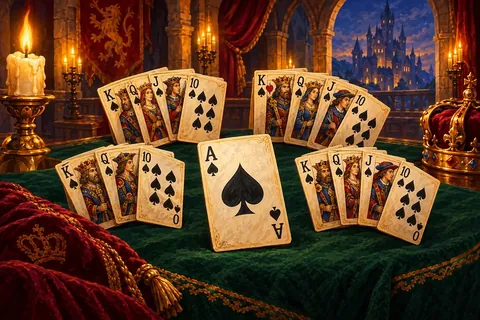
- A 32-card pack: ace, ten, king, queen, jack, nine, eight and seven in four suits.
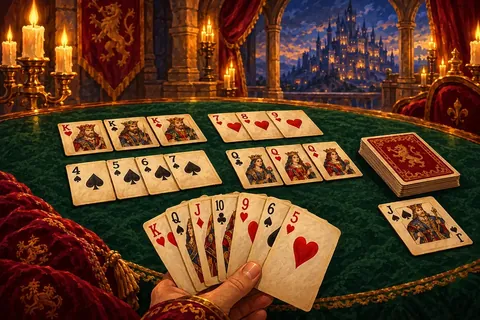
- Each player receives ten cards. Two cards are set aside face down as the skat.
- The player left of the dealer is Vorhand (forehand) and leads the first trick, the next is Mittelhand, and the dealer is Hinterhand. In our game you are Vorhand in the first game, and the deal then moves round.
- Card points: ace 11, ten 10, king 4, queen 3, jack 2, nines, eights and sevens nothing. All 32 cards add up to 120.
Bidding
- Mittelhand bids to Vorhand by naming a value: 18, 20, 22, 23, 24, 27, 30 and so on. These are real game values, not tricks.
- Vorhand answers "Yes" to hold that value or passes. Mittelhand keeps raising until one of them passes.
- Hinterhand then bids to the survivor in the same way.
- The last player standing wins the auction at the final value and becomes the declarer.
- If both other players pass without a bid, Vorhand may still play at 18 or pass as well; then the cards are thrown in and dealt again.
The skat and the choice of game
- The declarer either picks up the skat and lays any two cards away face down, or plays Hand and leaves the skat untouched. Laid-away cards count for the declarer at the end.
- The declarer names the game. In a suit game (clubs 12, spades 11, hearts 10, diamonds 9) the four jacks plus that suit are trumps. In Grand (24) only the four jacks are trumps. In Null (23) there are no trumps and the declarer must not win a single trick.
- In a Hand game the declarer may also announce Schneider, Schwarz or Ouvert, each raising the value. Null can be played Ouvert too, with the declarer's cards laid open on the table.
Playing the tricks
- Vorhand leads the first card; the winner of each trick leads the next.
- You must follow the suit led. Jacks always belong to the trump suit, never to their printed suit.
- If you cannot follow, you may play any card, a trump or a discard.
- The highest trump wins; otherwise the highest card of the suit led wins. The jacks rank clubs, spades, hearts, diamonds, then ace, ten, king, queen, nine, eight, seven of the trump suit. In Null the order is ace, king, queen, jack, ten, nine, eight, seven.
- After ten tricks each side counts the card points it has taken.
Scoring
The value of a suit game or Grand is its base value times a multiplier. The multiplier counts your matadors (how many top trumps you hold, or lack, from the jack of clubs down), plus one for the game, plus one each for Hand, Schneider (90 points or more, or the defenders kept to 30 or fewer), Schneider announced, Schwarz (every trick) and Schwarz announced, and Ouvert. Null games have fixed values: 23, Hand 35, Ouvert 46, Ouvert Hand 59.
If the game is won, the declarer adds its value to the list. If it is lost, the declarer loses twice the value. If the final value falls below the bid, the declarer has overbid and loses. Defenders score nothing. Our match runs over six games, and the highest total at the end wins.
Strategy
- Bid by the value of your best game, not by hope. Two or three jacks and a long suit are the usual backbone of a suit game.
- As declarer, draw trumps early so the defenders cannot ruff your aces and tens.
- As a defender, lead through the declarer toward your partner, and throw your partner high points when the trick is safe.
- Hand games are worth more, but only play Hand when the skat cannot rescue you anyway.
Common mistakes
- Treating a jack as part of its printed suit. It is always a trump in suit games and Grand.
- Forgetting that the ten outranks the king and is worth ten points.
- Laying away trumps or aces when a bare ten or a short suit should go instead.
- Overbidding by one step and losing a game you would have made at a lower bid.
Glossary
- Skat – the two face-down cards, and the name of the game.
- Reizen – the bidding.
- Vorhand, Mittelhand, Hinterhand – the three seats, left of the dealer first.
- Hand – playing without picking up the skat.
- Matadors – the unbroken run of top trumps you hold or lack.
- Schneider / Schwarz – 90 card points / all ten tricks.
- Ouvert – playing with your cards open on the table.
- Überreizt – overbid: the game turned out worth less than the bid.
FAQ
- Why are the jacks so strong?
- In Skat the four jacks are permanent top trumps in every suit game and in Grand. Only in Null do they drop back to their normal place.
- Do the cards I lay away count for me?
- Yes. The two laid-away cards, or the untouched skat in a Hand game, are added to the declarer's card points.
- What is the lowest bid?
- 18, the value of the cheapest diamond game with one matador. Every bid must be a value a real game can reach.
- Where can I practise these rules?
- Open our Skat page: the game deals at once, lets you play only legal cards and shows each game's value before you choose. For another deep trick game, see how to play bridge.