
How to Play Sliding Puzzle
Learning how to play the 15 puzzle game takes a minute; learning to solve it reliably takes one good method. This guide covers both, using the Sliding Puzzle on our site, which comes in 3 × 3, 4 × 4 and 5 × 5 sizes.
Play nowThe goal
Arrange the numbered tiles in order, reading left to right and top to bottom like a page of text. Tile 1 ends in the top-left corner, and the empty square ends in the bottom-right corner. On the 4 × 4 board that means 1 to 15; on 3 × 3 it is 1 to 8, and on 5 × 5 it is 1 to 24.
The board
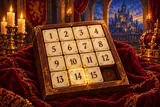
The frame holds one tile fewer than it has squares, which leaves a single gap. At the start the tiles are shuffled. Every board you are given can be solved, and at least half of its tiles start away from home, so there is always real work to do.
Choose the size in the New game dialog: Easy is 3 × 3, Medium is 4 × 4 and Hard is 5 × 5. The bar shows your time and your move count, and a tile that sits in its correct square is drawn with a different style so you can track progress.
Making moves
- Find the gap. Only the tiles in the same row or column as the gap can move.
- Tap a tile next to the gap to slide it across, or tap one further along the same line to slide the whole line towards the gap.
- Alternatively, swipe in the direction you want a tile to travel, or use the arrow keys or WASD on a keyboard.
- Every single tile that moves counts as one move, so a three-tile slide adds three.
- Keep going until every number is in place. The puzzle ends the moment the last tile slides home.
Scoring and winning
When the board is in order, the Victory screen shows your time, moves and score. The score rewards finishing in few moves, compared with how short a solution could be, and also falls slowly as time passes. Larger boards are worth more. From there, Next game gives you a fresh shuffle, and Play again repeats the same one.
A reliable solving method
- Solve the top row. Bring 1 and 2 into place first; they are easy, because the rest of the board is free to move around.
- Finish the row with a pair. For the last two tiles of a row, for example 3 and 4 on the 4 × 4 board, park 4 in the square where 3 belongs, then bring 3 directly below it. Now move the gap into the corner: 4 slides across into the corner and 3 rises into its own place.
- Repeat for each row until two rows are left. Never move a tile in a finished row again.
- Solve the last two rows column by column, left to right. Bring the top tile and the bottom tile of a column into place as a pair, using the same parking trick turned on its side.
- Finish the final 2 × 2 corner by cycling the three tiles around the gap until they fall into order.
Strategy notes
Think of the gap as a cursor. To move a tile one square left, the gap must first travel round to the left side of it, so plan the gap's journey before every tile.
Move a tile along its row first, then along its column, or the other way round, whichever disturbs fewer finished tiles. Slides along a whole line save taps but count the same as single moves.
Common mistakes
- Placing the last tile of a row first and then trying to squeeze the second-to-last in beside it. Use the pair trick instead.
- Breaking a finished row to fix a single tile. It nearly always costs more moves than it saves.
- Solving the last two rows row by row. Columns are much easier at that stage.
- Using undo to retrace a long path. Undo adds to the move count, so a forward fix is usually cheaper.
Glossary
- Gap: the empty square that tiles slide into.
- Home square: the place where a tile belongs in the solved board.
- Line slide: moving several tiles in one row or column with a single tap.
- Pair trick: placing the last two tiles of a row or column together.
- Parity: the hidden property that makes half of all shuffles unsolvable; our boards are corrected for it.
FAQ
- Can a sliding puzzle be impossible?
- On a real wooden puzzle with swapped tiles, yes. On our board, no: every shuffle is checked and repaired before you see it.
- How do I play Klotski here?
- This game is the numbered sliding puzzle rather than Klotski, which uses blocks of different shapes. The thinking is similar: free space first, then move the piece.
- What does the hint show?
- After a short video, it flashes the next tile to move on a good route to the solution.
- Where do I play?
- Open the Sliding Puzzle page; the board is shuffled and ready. For another ordering puzzle, try the Tower of Hanoi.