
How to Play Snakes and Ladders
Snakes and Ladders rules fit on the back of a postcard, which is why the game has been a family favourite for generations. This page explains how to play Snakes and Ladders exactly as it works in our free online version, step by step.
Play nowThe goal
Be the first player to reach square 100, the last square at the top of the board. Along the way, ladders carry you upwards and serpents send you back down. There is no other way to win and no way to stop the other players.
The board
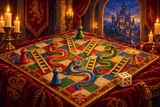
The board is a 10 by 10 grid with squares numbered from 1 to 100. The numbers run in a zig-zag: left to right along the bottom row, then right to left on the next row, and so on up to 100 in the top corner. Ladders join a lower square to a higher one, and serpents join a higher square to a lower one. In our game the snakes are called serpents, and the messages on screen use that word.
There are three boards to choose from in the New game dialog. Easy has 8 ladders and 4 serpents, Medium has 7 ladders and 7 serpents, and Hard has 5 ladders and 9 serpents.
Setup
All pieces start just off the board, before square 1. Against the computer there are four players: you as Ruby, plus Emerald, Topaz and Sapphire. In the 2 players mode, two people share the device. Ruby always rolls first and play then goes round in order.
Taking a turn
- Tap the die to roll it.
- Your piece moves forward by the number shown, following the zig-zag numbering.
- If it stops on the foot of a ladder, it climbs to the top of that ladder. The message Up the ladder! shows where you went.
- If it stops on a serpent's head, it slides down to the tail, with the message Whoops! Down the serpent.
- Your turn ends. In our version a 6 does not give an extra roll.
- The next player rolls.
The exact finish
To win you must land exactly on square 100. If you need 3 and roll a 5, your piece walks up to 100 and then bounces back two squares to 98. That bounce can even land you on a serpent near the top, which is where many games turn around at the last moment.
Winning
The first player to stand on 100 wins and the game ends. If you win, the victory screen shows the time, your number of rolls, and how many ladders and serpents you met. If a computer player gets there first, you can try again straight away.
Is there any strategy?
Honestly, no. You never choose which piece to move or how far, so the outcome depends only on the dice. In our game the dice sequence comes from a seed, so a whole game is decided the moment it starts; on the daily game everyone sees the same race. That is why there is no Undo and no Hint here.
What you can choose is the board. Pick Easy for a quick, upbeat game, Medium for a balanced one, and Hard if you enjoy a long, twisty race.
Playing together
- Try to predict where the piece will land before it moves. It adds a little game within the game.
- Point out the ladders and serpents within six squares; it builds a little suspense.
- Choose the Easy board for the youngest players so that climbs come often.
- Celebrate both directions. Sliding down is part of the fun, not a failure.
Common misunderstandings
- Thinking you climb a ladder by landing on its top. Ladders only work from the bottom.
- Expecting a second roll after a 6.
- Believing Hard means tougher opponents. It means a board with more serpents.
- Expecting to stop at 100 with any big roll. Only the exact number wins.
Glossary
- Ladder: a shortcut from a lower square up to a higher one.
- Serpent: our name for the snake, taking you from its head down to its tail.
- Bounce back: moving backwards from 100 by the extra steps of a too-big roll.
- Rolls: the counter in the bar that shows how many times you have rolled.
- Board: Easy, Medium or Hard, each with its own ladders and serpents.
Start playing
Head to Snakes and Ladders to play against three computer players, or open 2 player Snakes and Ladders to share the screen with a friend or family member.
FAQ
- Do you need a 6 to start in Snakes and Ladders?
- Not in our game. Pieces start just off the board and move on any roll.
- Do you need an exact roll to win?
- Yes. If your roll takes you past 100, your piece bounces back by the extra steps.
- Can two pieces share a square?
- Yes. Nobody is captured or blocked in Snakes and Ladders.
- Why are the snakes called serpents?
- It is simply the name used in our game. They work exactly like the snakes of the traditional board.