

How to Play Spider Solitaire
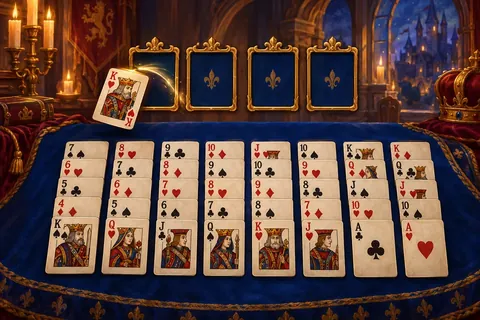
This guide explains how to play Spider Solitaire from the first deal to the last run, following the exact rules of our game. Spider looks crowded at first, with ten columns and two decks, but it rests on just two ideas: place cards by rank, and move them only in same-suit runs.
Play nowThe goal
Build eight complete sequences, each running from King down to Ace in a single suit. Every time you finish one, it is lifted off the table automatically. Clear all eight and the game is won.
Setup and layout
- Two decks, 104 cards in all. In 1 suit every card is of one suit, in 2 suits the deck is split between two, and 4 suits uses all four.
- Ten columns: the first four get six cards each, the last six get five each. The last card of each column is face up.
- The stock: the remaining 50 cards, waiting to be dealt in five rounds of ten.
- There are no free cells and no separate waste pile in Spider.
Moves, step by step
- Place a card on another card one rank higher. Suit does not matter for placing: a 7 of any suit can go on any 8.
- Pick up runs only in one suit. A group of cards can be moved together only if it is a descending sequence of the same suit, like 9, 8, 7 of hearts. A 9 of hearts on a 10 of clubs is fine to place, but the two will not move as a pair.
- Use empty columns. Any card or any same-suit run can be moved into an empty column.
- Uncover cards. When a face-down card is no longer covered, it comes face up and joins the play.
- Deal from the stock when you run out of useful moves. Each deal adds one card to every column. You cannot deal while any column is empty, so fill gaps first.
- Complete runs. When a full King-to-Ace run of one suit lines up in a column, it is removed by itself and counts toward the eight.
Scoring and the end of a game
Your score starts at 500. Every move costs 1 point, every deal from the stock costs 1, and every completed run earns 100. So a clean game with few wasted moves scores highest.
If the stock is empty and no move is left, the game shows a stuck dialog, where you can undo, try the same deal again or start a new one. While cards remain in the stock you are never declared stuck, because a deal can still change the picture.
Strategy that works
- Turn face-down cards over. Like most solitaire games, Spider is won by revealing hidden cards, and the short columns are the quickest to clear.
- Value empty columns above almost everything else. One empty column lets you take a mixed stack apart piece by piece.
- Build in suit when possible. A same-suit stack is flexible; a mixed one is a knot you will have to untie later.
- Before each deal, make the board as tidy as you can and refill all empty columns with the least useful cards.
- Do not be afraid to break up a run temporarily if it frees a column or uncovers a card.
Mistakes to avoid
- Dealing as soon as you feel stuck. Check every column first; the move you need is often a small one.
- Placing cards on mixed suits just because it is possible.
- Splitting a long same-suit run onto cards of other suits, where it can no longer travel as one piece.
- Treating the hint as a plan. It suggests one sensible move, nothing more, and in 2 suits and 4 suits following hints alone will not win.
Glossary
- Column: one of the ten vertical piles of cards.
- Run or sequence: cards in descending order; only same-suit runs can be moved as a group.
- Complete run: King down to Ace in one suit, removed automatically.
- Stock: the cards left after the deal, dealt ten at a time.
- Deal: putting one card from the stock on every column.
- Empty column: a column with no cards, open to any card or run.
FAQ
- How many suits should a beginner play?
- Start with 1 suit. You learn the moves without the problem of mixed stacks, then move up to 2 and 4.
- Why does the game refuse to deal?
- One of your columns is empty. A message reminds you to fill every empty column before dealing new cards.
- Is Spider harder than Klondike?
- With four suits, usually yes. With one suit it is often easier. Compare for yourself with Solitaire.
- Does undo have a limit?
- Not in practice. Undo is free and keeps hundreds of steps, though each undo is counted as a move.
- Where can I start playing?
- Go to Spider Solitaire and pick the number of suits in the New game dialog.