
How to Play Sudoku
Knowing how to play Sudoku comes down to three rules, and you can learn them in a minute. Getting good at it is a gentle journey of a few weeks. This guide covers both: the rules of the puzzle, how our game helps you along, and the techniques that take you from easy grids to expert ones.
Play nowThe rules
That is all. The starting digits, called givens or clues, are fixed, and your job is to fill in the rest. A properly made puzzle has only one solution, and every grid in our game is checked to guarantee that.
- Each of the nine rows must contain every digit from 1 to 9 exactly once.
- Each of the nine columns must contain every digit from 1 to 9 exactly once.
- Each of the nine 3 × 3 boxes must contain every digit from 1 to 9 exactly once.
The grid
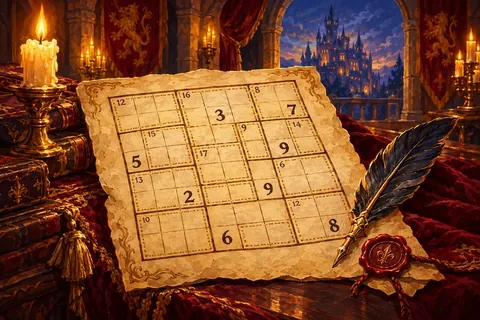
- 81 cells arranged in 9 rows and 9 columns.
- Thicker lines divide the grid into nine 3 × 3 boxes.
- Rows, columns and boxes are all called units; each cell belongs to exactly three of them.
- Easier levels start with more givens, harder ones with fewer.
How to enter digits in our game
- Tap or click a cell to select it. Its row, column and box are highlighted, and so are any cells with the same digit.
- Tap a digit below the grid, or type it on the keyboard. Arrow keys move the selection.
- To pencil in candidates instead, turn on notes with the Notes button or the N key, then tap digits.
- If a digit is wrong, it is shown as wrong at once and the Mistakes counter goes up. Erase it with the Erase button, Backspace, Delete or 0, or try another digit.
- Correct digits lock in place. When one is placed, it is removed from the notes of the cells it affects.
Solving techniques
Easy and Medium grids can be finished with scanning and singles. Hard grids often need notes. Expert grids are built so that singles alone will never be enough, so pairs and pointing become your everyday tools.
- Scanning: pick a digit and look at a box. If that digit already appears in the rows and columns crossing the box, only one cell may remain for it.
- Naked single: a cell where eight digits are already used in its row, column and box, so only one digit is left.
- Hidden single: a digit that has only one possible cell in a unit, even if that cell has other candidates too.
- Naked pair: two cells in a unit that can only hold the same two digits. Those digits can be crossed out of every other cell in that unit.
- Pointing: if, within a box, a digit can only go in one row or column, it cannot go anywhere else in that row or column outside the box.
Scoring and winning
You win when every cell is filled correctly. The win screen shows your time, moves, mistakes and score. Each level has its own base score, which goes down as time passes and by 100 for each mistake, but never below 100 points.
There is no mistake limit and no way to lose: you can always finish. A hint, unlocked with a short video, fills in one cell for you.
Beginner mistakes
- Guessing. If you are unsure, write notes instead of trying digits until one sticks; every wrong digit costs points.
- Scanning only rows. Boxes often reveal digits faster.
- Writing every candidate in every cell at the start. It clutters the grid; add notes where they help.
- Forgetting a unit. A digit must satisfy its row, its column and its box together.
Glossary
- Given or clue: a digit printed in the puzzle at the start.
- Cell: one of the 81 squares.
- Box: one of the nine 3 × 3 squares.
- Unit: any row, column or box.
- Candidate: a digit that could still go in a cell.
- Notes or pencil marks: candidates written small in a cell.
- Single: a cell or digit with only one possible placement.
FAQ
- Do I need maths to play Sudoku?
- No. There is no adding or multiplying. The digits could be any nine symbols.
- Where should a beginner start?
- With Easy puzzles on the Sudoku page. Move up a level once you finish easy grids without notes.
- Can a Sudoku have two solutions?
- A well-made one cannot, and ours never do. Each grid is tested for a unique solution as it is created.
- Can I take back a move?
- Yes. Undo is free and remembers many steps, so you can step back through notes and digits you have entered.
- Is there a daily puzzle?
- Yes, every day brings one shared puzzle for everyone. For a different kind of logic, try Minesweeper.