

How to Play TriPeaks Solitaire
This guide explains how to play TriPeaks Solitaire exactly as the game on this site works, from the layout to the last card. The rules fit in one sentence, play a card one rank above or below the pile card, but the real game is in choosing which card to play when several fit.
Play nowThe goal
Clear all 28 cards from the three peaks by moving them, one at a time, onto the pile below. You win as soon as the peaks are empty. Cards left in the stock do not stop you from winning; they add to your score instead.
The layout
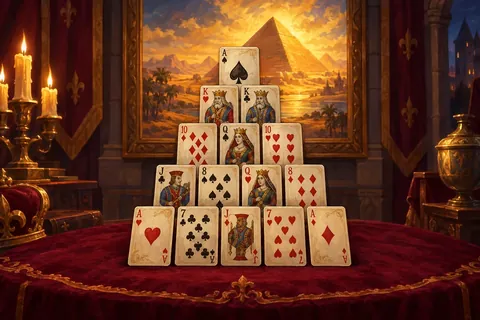
- Three peaks of 28 cards in four rows: 3 cards on top, then 6, then 9, then a bottom row of 10 that joins the peaks together.
- Only the bottom row starts face up. Every other card lies face down until the cards covering it are gone, then it turns over by itself.
- Below the peaks sit the stock (face down) and the pile, sometimes called the waste or foundation, which starts with one face-up card.
- The stock holds the other 23 cards of the 52-card deck.
Playing a turn
- Look at the card on top of the pile.
- Find a free peak card one rank higher or lower. Suits and colors do not matter. A free card has nothing overlapping it from the row below.
- Tap that card to move it to the pile, or drag it there. It becomes the new pile card.
- Keep going: the next card must be one rank away from the card you just played. You can change direction whenever you like, so 5, 6, 5, 4 is a legal run.
- When no free card fits, tap the stock to turn its top card onto the pile and start a new run from it.
- Repeat until the peaks are clear or the stock is empty and nothing fits.
Kings and Aces
In this version the ranks form a loop: King and Ace connect. On a King you may play a Queen or an Ace, and on an Ace you may play a 2 or a King. This wrap makes long streaks easier than in games where the Ace is a dead end.
The stock
The stock goes through once. There is no redeal, so when the last stock card is turned, the cards on the table are all you have. If no peak card then fits the pile, the No more moves screen appears and offers Undo, Try again, New game or Keep playing.
Scoring
- Each card moved from the peaks scores the value of your current streak: 1 for the first card after a stock turn, 2 for the second, 3 for the third and so on.
- Turning a stock card resets the streak.
- Each of the three top peak cards gives a bonus of 15 when cleared.
- At a win, every card still in the stock is worth 25 points.
- Time and moves are shown on the win screen alongside the score.
Strategy
Since streaks multiply your points and stock cards are precious, the best players treat each run as a small puzzle. Before playing, trace a few cards ahead: which choice leaves another match behind it? A card that frees a face-down card is usually worth more than one that does not, because it gives you new information.
Spread your attention across the three peaks. The upper rows are only reachable once the bottom row is broken up beneath them, and a peak left for last often lacks the ranks it needs. When you have a choice between equal moves, prefer the one on the peak with the most cards still hidden.
Finally, use the free undo to test ideas. If a run goes nowhere, step back and try the other branch.
Common mistakes
- Playing the first card that fits instead of the one that keeps the run going.
- Turning the stock while a playable card is still on the table.
- Forgetting that King and Ace connect and missing an obvious move.
- Clearing one peak completely while the other two stay locked.
Glossary
- Peak: one of the three triangular groups of cards.
- Free card: a peak card with nothing overlapping it, ready to play.
- Pile (waste): the face-up card you build on.
- Stock: the face-down cards you turn when stuck.
- Streak: a run of peak cards played without turning the stock.
- Wrap: the link between King and Ace.
FAQ
- Does suit matter in TriPeaks?
- No. Only the rank counts: one higher or one lower than the pile card.
- What happens when the stock runs out?
- You keep playing any peak cards that fit. When nothing fits, the round is over, though you can undo or try the same deal again.
- Is the deal always solvable?
- The game tries to deal a layout with a winning line, but that is not guaranteed for every game.
- How is this different from Golf Solitaire?
- Golf Solitaire uses seven open columns and has no King–Ace wrap, so a King or an Ace can end your run.