



Double Klondike

Double Klondike
Double Klondike solitaire takes the familiar rules of classic Klondike and doubles the deck. With 104 cards, nine columns and eight foundations, a game lasts longer and gives you more to plan, yet every move will feel natural if you have played the single-deck version.
A Draw 1 game, where you turn one card at a time, is dealt the moment you open this page. For turn three play, tap New game, choose Draw 3 and press Deal. The game runs free in your browser on a computer, tablet or phone.
How it works
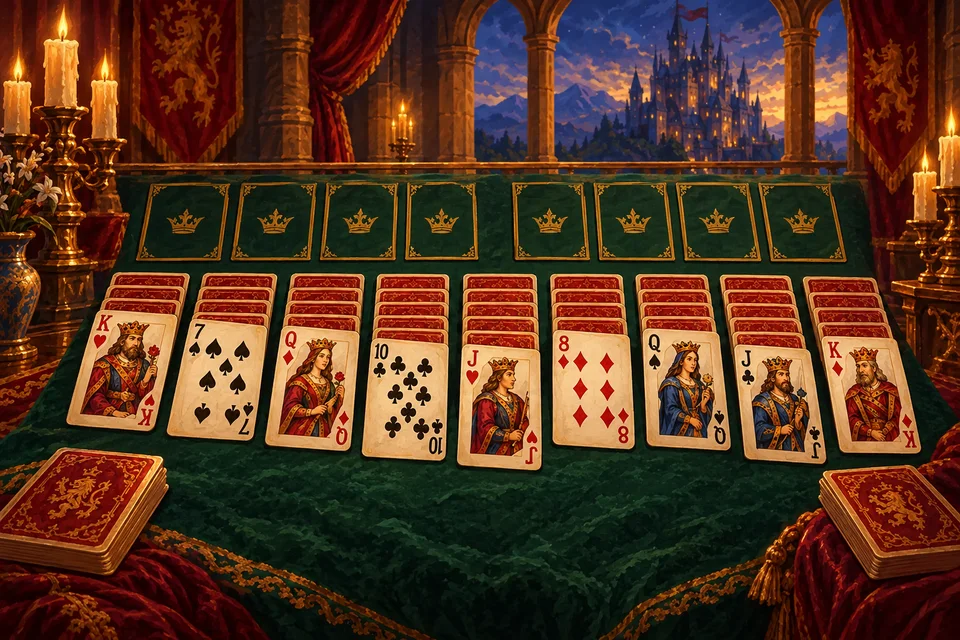
Nine columns are dealt, holding one card in the first up to nine cards in the last, with only the top card of each face up. The other 59 cards form the stock. Above the columns sit eight foundations, two for each suit, and each one is built from Ace to King in a single suit.
In the columns you build down in alternating colors, so a black 10 goes on a red Jack. Ordered runs can be moved together, and only a King, or a run headed by one, can fill an empty column. A face-down card turns over when the cards covering it are moved away.
Draw 1 and Draw 3
- Draw 1 (the default) turns one card from the stock onto the waste. Every card is reachable on every pass.
- Draw 3 turns three cards at once and shows all three, but only the top one is playable. It is the harder choice.
- In both modes you may go through the stock as often as you like. Each time the waste returns to the stock, your score drops: 50 points in Draw 1, 10 in Draw 3.
Score and helpers
- +10 for a card to a foundation, +5 for a card from the waste to a column, +5 for each card you turn face up.
- −15 for moving a card back from a foundation to a column. The score never falls below zero.
- A win in 30 seconds or more adds a time bonus: the faster you finish, the larger it gets.
- Once the stock and waste are empty and every card is face up, the remaining cards go home automatically.
- Undo is free. Hint costs a short video and shows a useful move or tells you to draw from the stock.
- Your game is saved in this browser, and the win screen shows your best score for the mode you played.
Tips
- Turn over face-down cards first. The right-hand columns hide up to eight cards each.
- With two of every card, you often have a choice of which red 7 to use. Pick the one that frees a hidden card.
- Move cards to the foundations steadily, but keep some mid-rank cards in the columns while you still need them to build on.
- Clear a column only when a King is ready to take its place.
- In Draw 3, think before recycling: each pass costs points and changes which cards come up.
FAQ
- How is this different from regular Klondike?
- It uses two decks, nine columns and eight foundations instead of one deck, seven columns and four foundations. The building rules are the same as in our classic Solitaire.
- Is there a limit on passes through the stock?
- No. You may recycle the waste as often as you like in both modes; each pass just costs some points.
- Is every deal winnable?
- No. The cards are shuffled at random and the deal is not checked, so some games cannot be finished.
- Do both foundations of a suit have to be built separately?
- Yes. Each foundation is its own Ace-to-King pile, and any Ace can start an empty one.
- Where can I read all the rules?
- Our Double Klondike rules page explains every step, and more games are among our solitaire games.