
How to Play Double Klondike
This guide covers how to play Double Klondike in our version, from the deal to the last card. If you know classic Klondike, most of it will be familiar; the bigger layout mainly changes how you plan.
Play nowGoal
Build eight foundations, two for each suit, from Ace up to King. The game is won when all 104 cards are on the foundations.
Setup
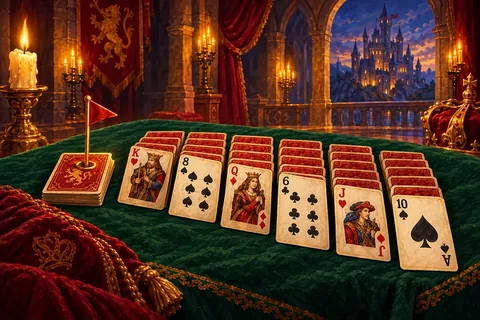
Two standard decks are shuffled together. Nine columns are dealt from left to right: the first gets one card, the second two, and so on up to nine cards in the last column. Only the top card of each column lies face up, so 36 cards begin hidden.
The 59 cards that remain make up the stock, placed at the top left with the waste beside it. The eight empty foundations sit along the top of the table, or in two rows of four on a narrow phone screen.
Playing, step by step
- Look for Aces. Any Ace can go to any empty foundation, and each foundation then grows in that suit only.
- Move face-up cards between columns, always placing a card on one of the opposite color and one rank higher: a red 5 on a black 6.
- Carry ordered runs as a group. Pick up a card that has a correct sequence on top of it and drop the whole run on a matching card.
- When a column's last face-up card leaves, the hidden card beneath turns face up.
- Fill an empty column only with a King, alone or with its run.
- Tap the stock to turn cards onto the waste: one at a time in Draw 1, three at a time in Draw 3. Play the top waste card onto a column or a foundation when it fits.
- When the stock is empty, tap it again to turn the waste back over and start a new pass. There is no limit on passes.
- Send cards to the foundations in order. A card on a foundation can be brought back to a column if you need it there.
Scoring and the finish
- Foundation card: +10 points.
- Card from the waste to a column: +5 points.
- Card turned face up in a column: +5 points.
- Card moved from a foundation back to a column: −15 points.
- Each new pass through the stock: −50 in Draw 1, −10 in Draw 3. The score cannot drop below zero.
- When the stock and waste are empty and nothing in the columns is face down, the game finishes the foundations for you.
- A winning game that lasted at least 30 seconds receives a time bonus that grows the faster you were.
Strategy
With two copies of every card, the game rewards patience. When two cards could take the same move, choose the one whose departure reveals a hidden card or empties a column you can use for a King.
The biggest columns sit on the right and hide eight cards apiece. Work on them steadily, because a long face-down stack blocks many of the cards you need.
Do not race everything to the foundations. Since each suit needs two complete piles, mid-rank cards may still be useful as building spots for cards of the other color. Move a card home when it is safe, not just because it can go.
In Draw 3, pay attention to the order of the waste. Playing one card from the waste shifts which cards will show up on the next pass, which can bring a stuck card within reach.
Common mistakes
- Emptying a column with no King ready, leaving a space that nothing else can use.
- Recycling the stock again and again in Draw 1 without making progress, which drains points quickly.
- Forgetting that there are two foundations per suit and leaving the second Ace in the waste.
- Building on the wrong copy of a card and burying a face-down stack under it.
Glossary
- Stock: the face-down pile of cards still to be turned.
- Waste: the face-up pile next to the stock; its top card is playable.
- Pass: one full trip through the stock.
- Foundation: one of eight piles built in suit from Ace to King.
- Run: a sequence of face-up cards in descending order and alternating colors.
FAQ
- What does turn one or turn three mean?
- It is how many cards you turn from the stock at a time. In our game the modes are called Draw 1 and Draw 3.
- Can I play a card from a foundation back to the table?
- Yes, if it fits on a column, but it costs 15 points.
- Is Double Klondike harder than the one-deck game?
- It is longer and needs more planning, though duplicate cards give you extra options. Compare it with our classic Solitaire to see which you prefer.
- Does the hint solve the game for me?
- No. It suggests a useful move or a draw from the stock, much like a friend glancing at the table, but it does not plan a full win.