
How to Play Nurikabe
These Nurikabe rules take you from a blank grid to a finished puzzle. Nurikabe was popularized by Japanese puzzle publishers and is played on a grid with a few numbers. You decide which cells are land and which are wall, and four simple rules pin down a single answer.
Play nowGoal of the puzzle
Split the grid into islands and a wall. In our game the wall is painted as sea, so you can think of it as water flowing around islands of land. The finished grid has to satisfy all of these rules:
- Each island contains exactly one numbered cell.
- The number tells how many cells that island has, the numbered cell included.
- All wall cells are connected into one piece, moving up, down, left or right.
- No 2×2 square anywhere is made entirely of wall.
Setup
Our game deals a 7×7 grid on Easy, 8×8 on Medium and 9×9 on Hard. The largest island is 4, 5 or 6 cells on those levels. Islands of size 1 can also appear. Every puzzle is generated on the spot and proven to have one solution before it reaches you; on slower phones you may see the board load for a moment.
How to mark cells
- Tap an empty cell to make it wall.
- Tap it again to place a dot, meaning "this belongs to an island".
- Tap once more to clear it.
- Hold and drag to paint the same mark across a row of cells.
- Use Undo to take back any tap or stroke.
Winning
The game checks the board after each move. As soon as your wall satisfies every rule, the grid lights up and the result screen shows your time, moves and score. The score depends on the level and on how quickly you finish, with a floor of 100. Dots are optional: any cell that is not wall is counted as land.
Solving techniques
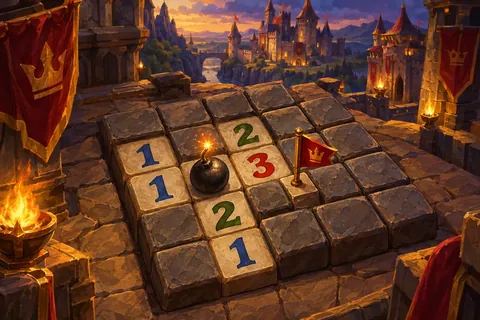
- Close the 1s. A 1 is an island on its own, so all four neighbors are wall.
- Separate the numbers. An empty cell next to two different islands must be wall, otherwise they would join.
- Unreachable cells. If a cell is too far from every number for any island to reach it, it is wall.
- Finished islands. When an island reaches its size, wall in every open cell around it.
- Wall escapes. A piece of wall with only one open neighbor has to grow through it to stay connected with the rest.
- Avoid pools. If three cells of a 2×2 square are wall, the fourth must be land.
- Island growth. If an island still needs cells and has only one direction to grow, extend it there.
A worked opening
Here is how a typical start looks. First find every 1 and wall in its neighbors; those cells are settled for good. Next look for empty cells that touch two different numbers or two growing islands. Any cell that would let two islands meet becomes wall.
Then turn to the large numbers. A 5 in a corner can only spread in two directions, so count how far it could reach and mark the cells beyond that limit as wall. With some wall in place, check the connection rule: a short piece of wall that is boxed in on three sides must escape through the fourth. Each new wall cell creates fresh 2×2 checks, and each finished island closes off more cells, so the grid usually falls into place step by step without any guessing.
Common mistakes
- Letting two islands touch side by side. Islands may meet only at corners.
- Building a 2×2 block of wall. The game shows it in red so you can spot it.
- Sealing off part of the wall. Every wall cell must link up with all the others.
- Counting the island size without the numbered cell. The number includes itself.
Glossary
- Island – a group of connected land cells around one number.
- Wall – the shaded cells, shown as sea in our game.
- Pool – a forbidden 2×2 square of wall.
- Dot – your mark for a cell you know is land.
- Clue – a numbered cell giving its island's size.
FAQ
- Can an island have no number?
- No. Every island needs exactly one number. A group of land cells without a number means some of those cells should be wall.
- What happens if I press Hint?
- After a short video, the hint corrects a wrong mark if there is one. Otherwise it marks a cell that is easy to deduce, such as a wall square between two islands or next to a 1.
- Are the levels graded by technique?
- The levels differ in grid size and the largest island. Bigger grids simply have more to work out, and every one has a single answer.
- What should I try next?
- Try Hitori, another shading puzzle, or look through all our puzzle games.