


Hitori

Hitori
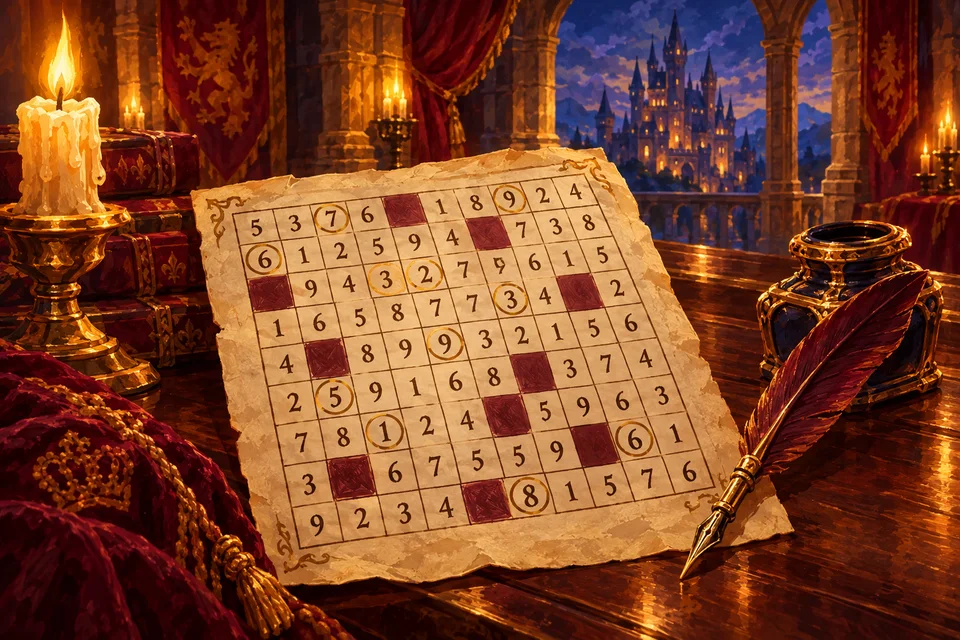
Hitori is a Japanese logic puzzle played on a grid full of numbers. You shade some of them until no number appears twice in any row or column. It sounds simple, but two more rules keep every move honest: shaded cells may not touch side by side, and the white cells must stay joined in one connected area.
A new Hitori puzzle on the Easy level is ready the moment this page opens, on a 6×6 grid. When you want a bigger challenge, tap New game, choose Medium or Hard and start a fresh grid. Every puzzle is generated for you and has exactly one solution, so careful reasoning always gets you there.
How it works
Tap a number once to shade it, tap again to circle it, which means you are sure it stays white, and a third tap clears the cell. You can also drag across the board to paint the same mark over several cells in one stroke. A small picture under the board reminds you of the tap order.
The game watches the rules for you. Two shaded cells side by side turn red, and so does a circled number that repeats another circled one in its line. When a row or column no longer holds any repeated number among its white cells, a little gem on the board's rim lights up. Once every rule is met, the puzzle is solved.
Easy, Medium and Hard
- Easy uses a 6×6 grid and can be solved with the basic patterns alone, such as pairs and sandwiches.
- Medium uses an 8×8 grid and needs at least one short "what if" check somewhere along the way.
- Hard uses a 10×10 grid and may ask for longer chains of reasoning. On a phone, a magnifier button appears so you can zoom in; pinch to zoom and drag with two fingers to move around.
Helpers on the bar
Undo takes back your last taps, one step at a time. The Hint button plays a short video and then helps in one of two ways: if one of your marks is wrong, it corrects that mark first and tells you so; otherwise it fills in the next cell that follows logically from what you have already marked. Your game is saved in the browser as you play, and the timer shows how long the grid has taken you.
Tips for solving
- Start with any number that sits between two identical numbers in a row or column. It must stay white, so circle it.
- When two equal numbers stand side by side, one of them stays white, so every other copy of that number in the same line can be shaded.
- Each time you shade a cell, circle all its neighbors at once. They can never be shaded too.
- Watch the corners and edges. Shading near them can cut off a white cell from the rest of the grid.
- Use circles generously. They turn guesses into facts and make the next step easier to see. When you have mastered this grid, Nurikabe offers a different kind of shading puzzle, and our puzzle section has many more.
FAQ
- Does every Hitori puzzle here have a single answer?
- Yes. Each grid is checked by a solver before you see it, and it is only kept when exactly one shading follows the rules.
- Is there a penalty for mistakes?
- No. Broken rules are shown in red so you can fix them, but there is no mistake counter and no lives. Your score depends on the level and how long you take.
- Can I play with a keyboard?
- Hitori is played by tapping or clicking the cells. There are no keyboard controls.
- Can diagonal shaded cells touch?
- Yes. Only shaded cells that share a side are against the rules. Corner to corner is fine.
- Where can I learn the full rules?
- Our page on how to play Hitori explains the rules, the standard solving patterns and common mistakes step by step.
More games
View all Popular Play
 Popular Play
 Popular Play
 Play
 Play
 Play