
How to Play Calcudoku
This guide explains how to play Calcudoku on our site. It takes a minute to learn the rules and a little practice to see how cages and rows work together. Below you will find the rules, the controls, a short worked example and the techniques that help on the bigger grids.
Play nowThe goal
Fill every cell of the grid so that each row and each column contains the numbers 1 up to the grid size exactly once, and every cage reaches its target with its operation. When the grid is full and correct, you win.
Grids and levels
Easy uses a 4 × 4 grid with the numbers 1 to 4 and only addition and subtraction. Medium uses 6 × 6 with 1 to 6 and adds multiplication. Hard uses 7 × 7 with 1 to 7 and all four operations. Choose a level in the New game dialog; each puzzle has exactly one solution.
Reading the cages
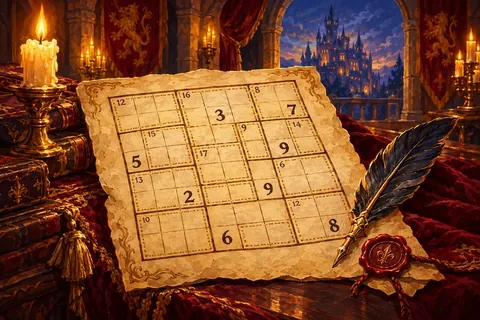
- A cage is a group of one to four connected cells inside a bold outline.
- The label in its top-left cell gives a target and a sign.
- + means the numbers in the cage add up to the target.
- − means the larger of the two numbers minus the smaller equals the target. These cages always have two cells.
- × means the numbers multiply to the target.
- ÷ means the larger number divided by the smaller equals the target. These cages also have two cells, and the division is always exact.
- A cage of one cell shows only a number with no sign: that is the cell's value.
- A number may appear twice in a cage if the two copies are in different rows and columns.
Entering numbers
- Tap a cell to select it.
- Tap a number on the keypad. Each key shows how many of that number you still have to place.
- To pencil in candidates, turn on Notes, by button or with the N key, and tap the numbers.
- To clear a cell, tap Erase or press Backspace, Delete or 0.
- On a keyboard you can also type numbers and move with the arrow keys.
Checking and winning
Every number is checked at once. A correct one is locked and also clears that note from its row and column. A wrong one turns red and adds to Mistakes; there is no limit. Finished rows, columns and cages flash.
When the grid is complete, the Victory screen shows time, moves, score and mistakes. Larger grids earn more, and time and mistakes reduce the score.
A small worked example
On a 4 × 4 grid, suppose a two-cell cage 7+ covers the first two cells of the top row. With the numbers 1 to 4, the only pair adding to 7 is 3 and 4. Now suppose a cage 3− covers the second and third cells of the first column. The only pair that differs by 3 is 1 and 4, so the first column already has its 4 somewhere in that cage. The top-left cell therefore cannot be 4: it is 3, and its neighbour in the 7+ cage is 4. Two numbers placed from two clues and the column rule.
Solving techniques
- Single cells first: write in every one-cell cage.
- Extreme targets: the largest and smallest targets for a cage size have few combinations. On 6 × 6, 11+ in two cells is 5 and 6; 3+ is 1 and 2.
- Factor the products: 15× on 6 × 6 must be 3 and 5; 24× in two cells must be 4 and 6.
- Row totals: every row on an n × n grid has the same sum. On 7 × 7 it is 28, which helps find a last missing value.
- Pairs: if two cells in a row can only hold 2 and 5, no other cell in that row can hold 2 or 5.
Common mistakes
- Treating subtraction as order-dependent. 2− means the difference is 2, whichever cell is larger.
- Forgetting that a cage of three cells can repeat a number in an L shape.
- Writing numbers larger than the grid size, such as a 7 on a 6 × 6 grid.
- Ignoring the rows and columns while concentrating on one cage.
Glossary
- Cage: an outlined group of cells with a target.
- Target: the number a cage must produce.
- Operation: the sign that says how: +, −, × or ÷.
- Latin square: a grid where each row and column holds every number once.
- Notes: small candidate numbers you write in a cell.
FAQ
- What does the hint do?
- After a short video it fixes the selected cell if it is wrong, or else fills a single-cell cage or the cell with the fewest options.
- Are there cages with hidden operations?
- No. Every cage on our site shows its sign.
- Can a cage be bigger than four cells?
- No. Cages have between one and four cells.
- Where can I play?
- Open the Calcudoku page for a fresh puzzle. If you like it, try Futoshiki next.