


Calcudoku
Calcudoku
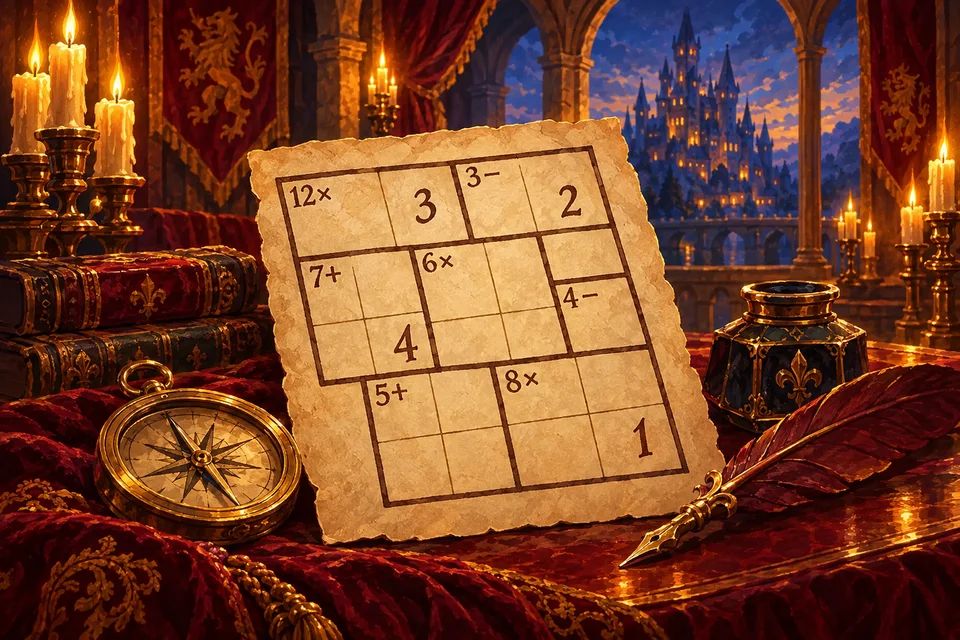
Calcudoku is a number puzzle that mixes Sudoku-style logic with simple arithmetic. Fill the grid so that every row and every column contains each number once, while each outlined cage produces its target with the operation shown. The puzzle on this page is ready to play; tap a cell to start.
The arithmetic never goes beyond small numbers. The real challenge is combining what the cages allow with what the rows and columns still need.
How it works
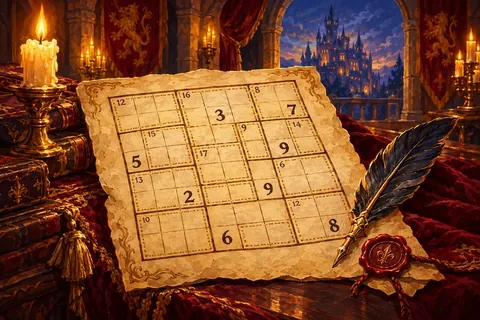
On an n × n grid, each row and column holds the numbers 1 to n exactly once. The grid is divided into cages of one to four cells. Each cage shows a target and a sign in its top-left corner: 7+ means its numbers add up to 7, 2− means the difference of its two numbers is 2, 12× means they multiply to 12, and 3÷ means one divided by the other gives 3. A single-cell cage shows just a number, which you can write straight in.
A number may repeat inside a cage as long as the copies sit in different rows and columns.
Three levels
Subtraction and division cages always have exactly two cells, and division always comes out even. Every puzzle has exactly one solution.
- Easy: 4 × 4 grid with addition and subtraction.
- Medium: 6 × 6 grid with addition, subtraction and multiplication.
- Hard: 7 × 7 grid with all four operations.
Controls and helpers
Tap a cell, then a number on the keypad, which shows how many of each number are still to place. Notes let you pencil in candidates, and Erase clears a cell. On a keyboard, type the numbers, use Backspace, Delete or 0 to erase, N for notes and the arrow keys to move.
Numbers are checked straight away. A correct one is locked and removed from the notes in its row and column; a wrong one turns red and adds to Mistakes. There is no mistake limit. Finished rows, columns and cages flash.
Tips
- Fill single-cell cages first; they are free numbers.
- On a 6 × 6 grid, a 2-cell cage of 11+ must be 5 and 6, and a 2-cell cage of 5− must be 1 and 6.
- Products narrow things down fast: on 6 × 6, 30× in two cells can only be 5 and 6.
- Use the row and column rule constantly. If a row needs only 2 and 4, any cage there must accept one of them.
- Each row adds up to the same total, for example 21 on a 6 × 6 grid, which can reveal a last missing number.
Hints and rules
The Hint button, unlocked with a short video, corrects the selected cell if it is wrong; otherwise it fills a single-cell cage or the cell with the fewest options. The complete rules are in how to play Calcudoku.
FAQ
- Is Calcudoku like Sudoku?
- It shares the rule that each row and column holds every number once, but there are no 3 × 3 boxes. Cages with arithmetic targets take their place.
- Are the operations always shown?
- Yes. Every cage shows both its target and its sign.
- In which order do I subtract or divide?
- Always the larger number minus or divided by the smaller one, whichever cell it is in.
- Is there a mistake limit?
- No. Wrong numbers are marked and counted, but the game never ends early.
- What is similar?
- Kakuro is built on sums alone, and Futoshiki uses the same row and column rule with greater-than signs.
More games
View all Popular Play
 Popular Play
 Popular Play
 Play
 Play
 Play