


Futoshiki
Futoshiki
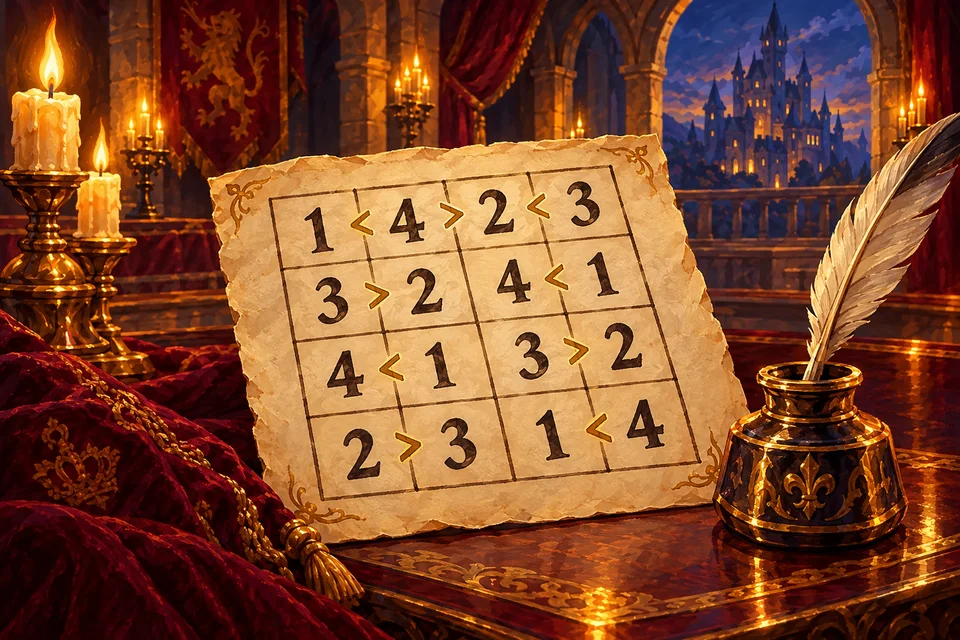
Futoshiki is a Japanese number puzzle built on a simple idea: fill the grid so every row and column contains each number once, while the little greater-than and less-than signs between cells stay true. A few numbers are given to start you off. The puzzle on this page is ready; tap a cell to begin.
The name means not equal, and that is the heart of it: every sign tells you which of two neighbours is bigger.
How it works
On a 5 × 5 grid you place the numbers 1 to 5, on a 6 × 6 grid 1 to 6, and so on. Each row and each column must hold every number exactly once, as in Sudoku but without boxes. Between some neighbouring cells there is a sign: the open side faces the larger number, and the arrow points to the smaller one. A cell with a 1 can never be on the open side; a cell with the largest number can never be on the pointed side.
Tap a cell, then a number on the keypad, which also shows how many of each number are still to place. Notes let you pencil in candidates, and Erase clears a cell. On a keyboard, type numbers, use Backspace, Delete or 0 to erase, N for notes and the arrow keys to move.
Three sizes
Every puzzle has exactly one solution.
- Easy: 5 × 5, with a few extra signs and given numbers.
- Medium: 6 × 6, with one extra sign and given number.
- Hard: 7 × 7, with only the clues that are strictly needed.
Checking
Numbers are checked straight away against the solution. Correct ones and the starting numbers are locked; a correct number also removes that note from its row and column. A wrong number turns red and adds to Mistakes. There is no limit, so you can always finish.
Tips
- Follow chains of signs. If a < b < c < d in a 5 × 5 row, the smallest of them is at most 2 and the largest at least 4.
- A cell on the pointed side of any sign cannot be the largest number; a cell on the open side cannot be 1.
- Combine signs with the row rule: when a row has only one place left for its 5, it goes there.
- Use notes on cells with two or three options, and clear them as the grid fills.
- The score falls with time and with mistakes, so check signs before committing.
Hints and rules
The Hint button, unlocked with a short video, fixes the selected cell if it is wrong; otherwise it fills the open cell with the fewest options. Read the full guide in how to play Futoshiki.
FAQ
- Which way do the signs point?
- The open side faces the larger number and the point faces the smaller, as in ordinary maths.
- Is Futoshiki harder than Sudoku?
- The grids are smaller, but the signs add a different kind of logic. Easy 5 × 5 is a gentle start.
- Are signs checked when I break them?
- Numbers are checked against the solution, so a wrong number turns red whether or not it breaks a sign.
- Is there a mistake limit?
- No. Mistakes are counted but never end the game.
- What is similar?
- Calcudoku shares the row and column rule with arithmetic cages, and Sudoku adds 3 × 3 boxes.
More games
View all Popular Play
 Popular Play
 Popular Play
 Play
 Play
 Play