


Slitherlink
Slitherlink
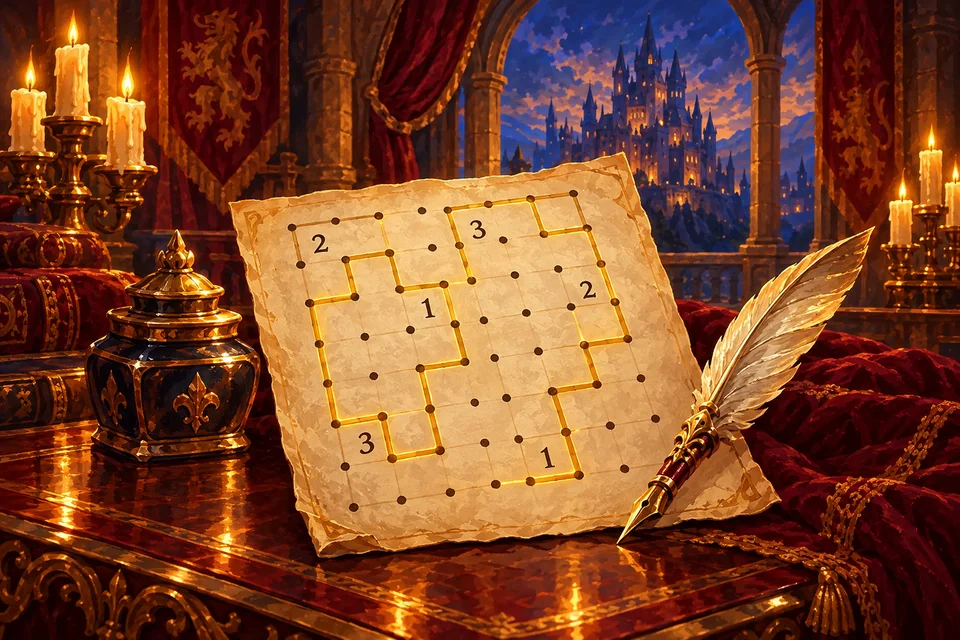
Slitherlink is a loop puzzle. On a grid of dots, draw a single closed loop along the lines between them, with no branches and no crossings. Numbers inside the squares tell you how many of their four sides the loop runs along. The Slitherlink puzzle on this page is ready; tap a line between two dots to start drawing.
Few puzzles look so plain and play so cleverly: every number is a small constraint, and together they fix one single loop.
How it works
- Draw exactly one loop that closes on itself.
- The loop never branches and never crosses itself, so every dot has either no line or exactly two.
- A number in a square is how many of that square's four sides are part of the loop.
- Squares without a number can have any number of sides on the loop.
Drawing
Tap near an edge to cycle it through line, cross and empty. A cross is your note that the loop does not use that edge. Drag along several edges to give them all the same mark, which makes long straight runs quick to draw.
The grid helps as you go: a dot touched by more than two lines is flagged, a number with too many lines or too many crosses around it is flagged, and a satisfied number shows as done.
Three sizes
Each loop is the outline of a random shape, and every puzzle has exactly one solution.
- Easy: 5 × 5 squares, with many numbers left in.
- Medium: 7 × 7 squares.
- Hard: 10 × 10 squares, with far fewer numbers.
Tips
- Start with 0s: cross all four of their sides.
- A 3 in a corner of the grid always uses both of its outer corner sides.
- Two 3s side by side share the line between them, and their outer sides are lines too.
- Every dot needs zero or two lines. If a dot has one line and only one free edge, the loop continues there.
- Cross edges as soon as you know they are empty; they guide the loop as much as lines do.
Hints and rules
The Hint button, unlocked with a short video, first fixes a wrong mark and tells you so; then it gives an edge that logic forces, or failing that, a loop edge next to your lines. The score depends on time. For patterns and a full walkthrough, see how to play Slitherlink.
FAQ
- Can there be more than one loop?
- No. The solution is a single closed loop through the grid.
- Do I have to place crosses?
- No, crosses are notes for you. Only the lines are compared with the solution.
- Is there a mistake counter?
- No. The grid flags broken rules, but nothing is counted against you.
- Can I play with a keyboard?
- No. Slitherlink is played by tapping and dragging.
- What is similar?
- Bridges is another puzzle of lines and numbers, and Nonogram rewards the same careful elimination.
More games
View all Popular Play
 Popular Play
 Popular Play
 Play
 Play
 Play